4 Foods I Avoid as a Nutritionist (and What I Choose Instead)

Join the List
Sign up to receive Tips for Easy Sustainable Weight Loss + bonus recipes in your inbox!
Have you ever been guilty of grocery cart snooping?
After writing this, I may have to start grocery shopping in another town.
Because although I shamelessly used the word “avoid” in the title, I should probably clarify something right from the start.
I try to keep things pretty moderate when it comes to food — and life, actually.
But moderate doesn’t mean I don’t draw a line.
I don’t believe we need to eat perfectly. And if you’ve been around here for a while, you probably know that I like to indulge as much as the next person.
But there are a few ingredients and foods that, knowing what I know about nutrition, I simply choose to avoid when I’m doing my grocery shopping.
1. Foods Containing Artificial Sweeteners
I’m talking about ingredients like aspartame, sucralose and saccharin.
The research around artificial sweeteners is complicated. There are ongoing questions around their effects on things like metabolic health and the gut microbiome.
They’re also incredibly common in foods marketed as “low sugar,” “sugar-free,” “diet” or even “healthy.”
Look for artificial sweeteners in:
- Diet and zero-sugar sodas and drinks
- Flavoured yogurts
- Sugar-free gum and mints
- Sugar-free desserts
- Jams, cereals, bars and instant oatmeal
- Coffee creamers and syrups
- Keto and low-carb products
- Flavoured electrolyte powders and vitamin drinks
- Gummies and chewable supplements
What do I choose instead?
Give me a little maple syrup, honey or even real sugar any day.
That doesn’t mean unlimited sugar is a health food. It simply means that when I want something sweet, I generally prefer a small amount of the real thing.
2. Partially Hydrogenated Oils and Artificial Trans Fats
Okay, maybe a little of these fats may slip in once in a while.
I’m not inspecting every cracker at a cocktail party.
But they’re something I actively avoid when I’m grocery shopping.
Artificial trans fats have a well-established relationship with cardiovascular risk and inflammation, which is enough reason for me to keep them out of my cart.
Food manufacturers have traditionally used these fats because they’re inexpensive, shelf-stable and can improve the texture of processed foods.
When you’re reading food labels, watch ingredient lists for terms such as “partially hydrogenated oil.”
They may turn up in foods such as:
- Commercial baked goods
- Packaged cakes, cookies, pie crusts and crackers
- Shortenings
- Some spreads and margarines
- Packaged snacks
- Ready-to-use frostings
- Coffee creamers
- Highly processed foods
Again, I’m not suggesting you panic if you discover you’ve eaten something containing one of these ingredients.
My approach is much simpler: if I’m standing in the grocery store choosing between two products, I’ll leave the partially hydrogenated oils on the shelf.
3. Most Packaged Breakfast Cereals
I know this one may get me unfollowed.
Many packaged breakfast cereals are essentially highly processed grain products with vitamins and minerals added to them.
They’re certainly not always the nutritional superheroes the front of the box would have us believe.
If cereal is a regular part of your breakfast, here are a few things worth looking at.
Processing
Many breakfast cereals are made from grains that undergo considerable processing to turn them into flakes, puffs, loops and other funky shapes.
Added sugar
“Organic,” “natural” and even “whole grain” don’t necessarily mean low in added sugar.
Protein
Many cereals provide relatively little protein on their own.
And a breakfast that’s lacking in protein may not keep you feeling full and satisfied for very long.
Fibre
The amount of fibre varies considerably between cereals. Some are good sources, while others provide surprisingly little.
Again: turn over the box and check.
Highly processed ingredients
Some cereals also contain long ingredient lists with flavours, colours, sweeteners and other ingredients that I’d simply rather leave on the shelf.
Does this mean cereal is forbidden?
Of course not.
But if you’re eating it regularly, choose one with a short ingredient list, plenty of fibre, minimal added sugar, and consider pairing it with a good source of protein.
4. Most Flavoured Dairy Products
I’m not anti-dairy.
I’m actually a fan of good-quality dairy if you tolerate it well.
I just prefer to flavour it myself.
Give me plain Greek yogurt with berries, vanilla, cinnamon and a drizzle of maple syrup or honey.
That way, I control the sweetness and I know exactly what’s going into it.
Some flavoured dairy products can contain significant amounts of added sugar along with flavours, colours, thickeners and other ingredients that simply aren’t necessary.
And this is where reading the ingredient list becomes much more useful than relying on whatever health claim happens to be splashed across the front of the package.
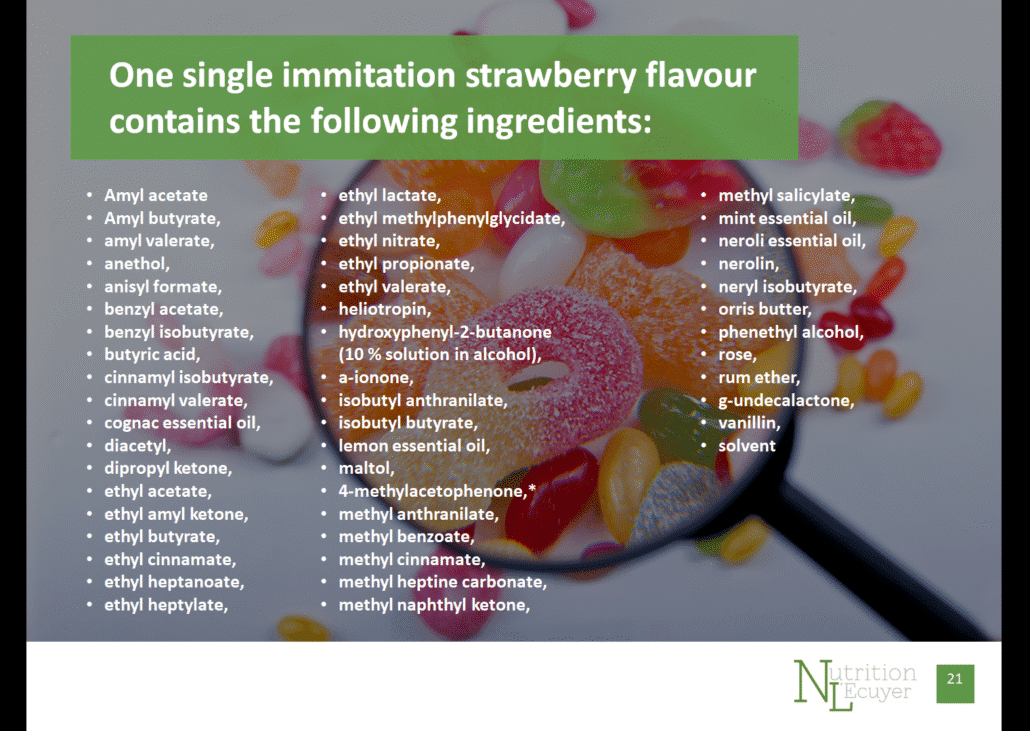
Example of the ingredients that may be used to create an artificial strawberry flavour.
So… What the Heck Am I Supposed to Feed My Family?
I realize a post like this can leave you thinking:
What the heck am I supposed to feed my family?
I remember feeling exactly like that when I first started learning about nutrition.
But here’s the part I really want you to remember:
You don’t need to overhaul your entire kitchen this weekend.
You don’t need to eat perfectly.
And you definitely don’t need to become the person interrogating the waiter about every ingredient in the salad dressing.
Start smaller.
Just start by turning over the package. 💛
Read the ingredient list.
Look at the added sugar, fibre and protein.
Compare one product with another.
And then make the best choice you can with the information you have.
That’s how better nutrition becomes sustainable — not through perfection, but through lots of small, informed choices made over time.
Need Help Making Sense of Nutrition?
Nutrition can feel ridiculously complicated.
My job is to help you understand your body, your habits and your food choices so that you can make decisions you actually feel good about — and still enjoy your life.
If that sounds like the kind of support you’re looking for, book a free discovery call with me.
We’ll talk about where you are, where you’d like to be, and whether working together might be a good fit.
Kim
xo
Join the List
Sign up to receive Tips for Easy Sustainable Weight Loss + bonus recipes in your inbox!